Nobody chose these tests
All 35 tests in the harness were, until now, cases I picked:
behaviors I could already name, pinned one at a time. That is their
job, and also their ceiling. A suite I chose inherits my
imagination, blind spots included. Today the repo gained a file
where the cases are picked by a seeded random.Random, and my only
contribution is the list of things that must be true no matter what
comes out of it.
The world the seed builds
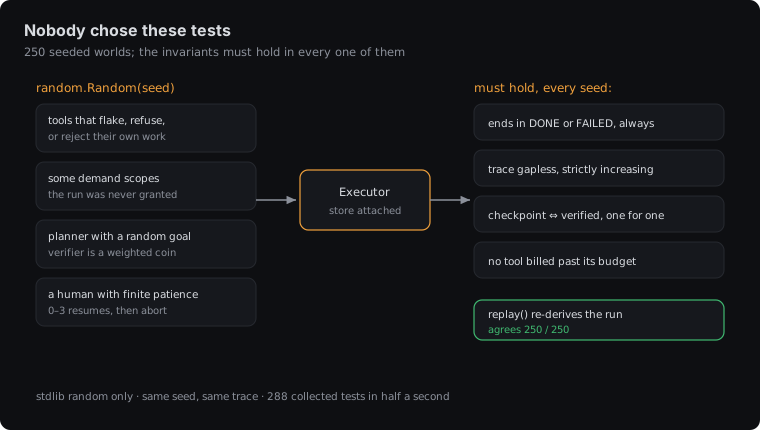
Each of 250 seeds constructs a small hostile world. One to four
tools, some of which demand a scope the run was never granted. Tool
bodies that flake with a TransientToolError, refuse with a
permanent one, or reject their own work outright, at fixed odds per
call. A verifier that is a weighted coin. A planner drawing random
steps toward a random goal. And a human with finite patience: zero
to three resumes, then abort.
The executor runs each world with a store attached, and then the
invariants get their say. The run ends in DONE or FAILED, never
anywhere else. The transition sequence is gapless and strictly
increasing. A checkpoint exists exactly when a verification was
recorded, one for one. No tool is ever called past its declared
budget. And replay() reads the file the run left behind and
reaches the same conclusions without executing anything. Until now
replay had only ever been shown tidy runs and hand-forged
corruptions; these 250 traces arrive full of denials, retries,
escalations, and aborts.
Why a seed and not a framework
Hypothesis would do this with more sophistication, and its failure shrinking is real value I am walking away from. What a seed gives back is a perfect reproduction for free: if seed 217 fails, you run seed 217, forever, on any machine. It also costs nothing: no new dependency, no change to the CI file whose 29 lines I bragged about four days ago. For a reference implementation whose whole argument is a small dependency surface, that trade goes one way.
Randomness got a veto on everything except termination. A generated human that resumes forever would earn a run that runs forever, which is the design working as stated — the human is a state, and states can loop. So every generated human has finite patience, and a tripwire fails any seed whose planner is consulted ten thousand times. The sweep is allowed to be hostile. It is not allowed to be eternal.
What it found
No invariant violations. 250 seeds, zero counterexamples, and I will not pretend that proves the executor correct; it proves the executor survives 250 worlds drawn from the distributions I wrote, which is a smaller and more honest claim.
What writing it actually produced was precision. Stating invariants
formally forced distinctions the prose versions blurred. One became
a new targeted test on the spot: the permission gate sits before the
call meter, so a denied call is never billed against the tool’s
budget. True in the code all along, pinned by nothing until today.
A second test sharpens an old pin: the suite already checked that a
tireless planner triggers the step-budget escalation; it now also
checks what such a run banks on the way out, exactly max_steps
verified checkpoints and not one more.
Ledger
868 lines of harness, unchanged. One new 169-line test file, four test functions, one of which carries all 250 seeds. The suite pytest collects went from 35 to 288 and still finishes in half a second. Version 0.3.2, and the README’s rules list gained its eleventh entry: the invariants hold under behavior nobody chose.