The model was never the product
In 2023 I watched AutoGPT burn through $40 of API credits trying to order a pizza. Everyone laughed. Everyone forked it anyway, and “agent” went on to become the most overloaded word in the industry. Three years later the correction has arrived, and to me it’s the most important shift in AI engineering right now: we stopped building agents and started building harnesses.
You could see it all over AI Engineer World’s Fair this year. The talks weren’t about autonomy. They were about the machinery around the model: context management, permission boundaries, evaluation loops, continuous improvement. Lilian Weng’s updated framework even gives the thing a name, harness engineering. The model is an engine component. The harness is the vehicle. Nobody ships an engine to a customer.
Why autonomy lost
The math was never on autonomy’s side. I think most of us knew it before we admitted it. If each step of an agent chain succeeds 95% of the time (generous), a 20-step unsupervised run completes correctly about 36% of the time. That’s not a product. That’s a slot machine with a system prompt.
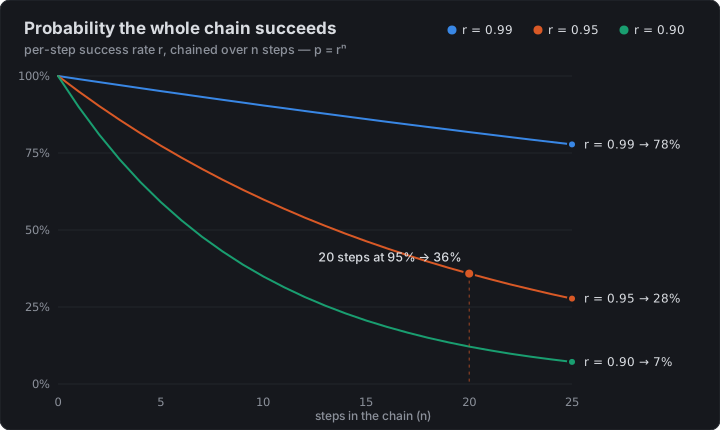 The exponent is the enemy. Even at 99% per step you lose a fifth of your
runs by step 25.
The exponent is the enemy. Even at 99% per step you lose a fifth of your
runs by step 25.
The teams that actually got things into production didn’t wait for a smarter model to fix the exponent. They restructured the problem so the exponent stops mattering: shorter loops, checkpointed state, verification after every step that can be verified, and a human placed exactly where judgment is needed. The outer-loop/inner-loop pattern that got so much airtime this year is this idea formalized. Autonomous inner loops, humans supervising from an outer loop of evals and feedback signals. It’s control theory arriving in AI systems, about a decade after SREs started doing the same thing with error budgets. We’re not inventing anything here. We’re finally applying our own discipline to our newest dependency.
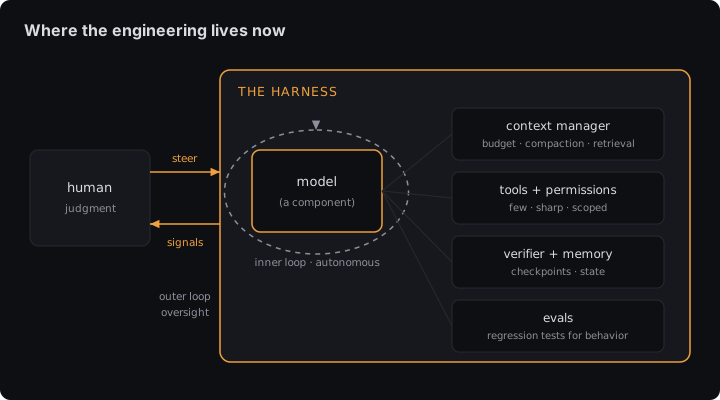 My mental model of the 2026 stack. The box worth studying is not the one
labelled “model”.
My mental model of the 2026 stack. The box worth studying is not the one
labelled “model”.
Context is a systems resource. Treat it like one.
The other half of this shift is that context engineering grew up. What started as prompt-hacking folklore is now a real discipline, and it’s the part I enjoy most, because it behaves exactly like the resource-management problems backend people have been dealing with for decades.
The context window is memory. It fragments. It degrades. Chroma’s context-rot study shows accuracy falling as token counts grow, and the lost-in-the-middle effect means position matters as much as presence. So the winning patterns look suspiciously like an operating system: admission control before anything enters the window, compaction when pressure builds (garbage collection, basically), just-in-time retrieval instead of preloading, re-rankers enforcing hard top-k caps.
And the numbers say retrieval quality dominates everything else. A benchmark Sourcegraph published in March compared naive grep against indexed, code-aware retrieval on enterprise tasks. Vendor numbers, measuring their own product, so salt to taste. The direction still holds. Precision@5 went from 0.14 to 0.478. A cross-file refactor dropped from 96 tool calls over 84 minutes to 5 calls in under five minutes. That’s a 19x win with no model change. When did a model upgrade last give you 19x? The leverage moved into the harness. Most budgets haven’t noticed yet.
Tools tell the same story. The most common failure mode in agent systems isn’t hallucination, it’s bloated tool sets. Every tool definition you register is a context tax and a decision surface. Ten sharp tools beat forty vague ones. This is API design. We’ve known how to do it for twenty years; we just keep pretending it’s new.
The part I’m skeptical about
“Skills” were everywhere this year: portable, Markdown-encoded workflows
that agents load and execute, now on every major platform. I like the
idea. Encoding team knowledge as versioned, reviewable text files beats
burying it in prompts. But I’ve seen this movie in config management.
Today’s elegant skill library is next year’s utils/ folder. One speaker
at World’s Fair warned about “skills hell”
and he’s right. Without ownership, review discipline and a deprecation
policy, we’re inventing prompt sprawl with better marketing.
Geoffrey Huntley’s caution from the same event stuck with me too: loops are frontier thinking we still haven’t figured out. Agreed. Anyone selling you a solved agentic platform in 2026 is selling you their roadmap.
What this means if you build platforms
The uncomfortable conclusion is that the differentiating work in AI right now is boring, and that’s exactly why it’s valuable. State management. Retrieval indexes. Eval suites that run like regression tests. Observability that can answer “why did the agent do that” three weeks after it did it. Permission models. The people best positioned for this aren’t prompt artists. They’re distributed-systems engineers who took the time to learn how models fail.
That’s the bet this whole site is built on, frankly.
What I’m watching next: whether harnesses standardize the way web frameworks did, or stay bespoke per company. MCP pushed the tool-interface layer toward a standard. Nothing equivalent exists yet for loops, evals or memory. If that standard shows up in the next 18 months, it will matter more than whatever model release gets announced next to it.
The model was never the product. The system around it always was. It just took the industry three years and a lot of pizza money to admit it.
Building in this layer too? My inbox is open — details on the about page.