800 kilobytes per token
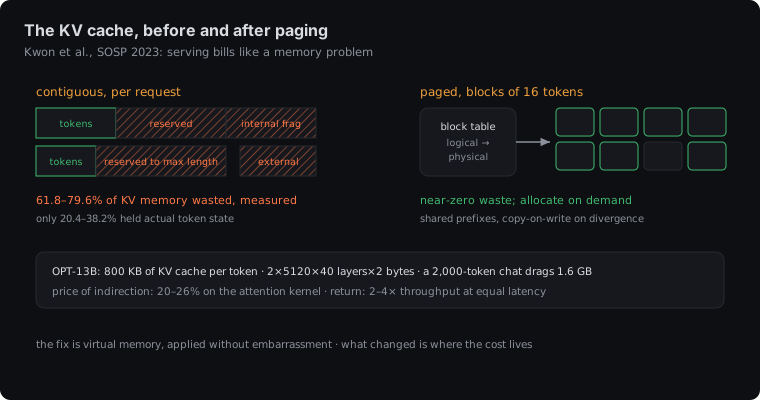
One token of context in OPT-13B costs 800 kilobytes of KV cache: two vectors, 5120 wide, across 40 layers, in FP16. Hold a 2,000-token conversation and the model is dragging 1.6 gigabytes of state behind it, per request, before a single new token is computed. The PagedAttention paper (Kwon et al., SOSP 2023, the paper behind vLLM) starts from that arithmetic, and the arithmetic is the whole argument: LLM serving looks like a compute problem and bills like a memory problem.
The measured indictment
Before proposing anything, the authors measure what existing serving systems did with that memory, and the number deserves to be quoted exactly: 61.8 to 79.6 percent of KV cache memory wasted. Only a fifth to a third of it held actual token state. The waste has three named sources, and anyone who has run a memory allocator will recognize all of them: slots reserved for tokens not yet generated, internal fragmentation from provisioning every request for its maximum possible length, and external fragmentation from the allocator itself. Serving systems were burning most of their scarcest resource on bookkeeping failures that operating systems classified, named, and solved decades ago.
The old answer, imported honestly
The fix is virtual memory, applied without embarrassment. Chop the KV cache into fixed blocks of sixteen tokens, keep a block table per sequence mapping logical to physical, allocate on demand, share read-only blocks across sequences, copy on write when a shared block diverges. Beam search stops copying whole caches and starts sharing prefixes. Every sentence of that description could have come from an OS textbook, and the paper is candid about the lineage.
What makes it architecture rather than borrowing is where the cost went. Contiguity was never a law of nature; it was a contract the attention kernel imposed on the storage layer. The authors moved that constraint out of the contract and paid for it inside a rewritten kernel that walks the block table. Utilization became near-total, and the price is indirection on every attention read: 20 to 26 percent higher attention-kernel latency by their own microbenchmark, diluted to little at system level because attention is one operator among many. Naming the price is what makes the trade honest, and the outcome at system level is 2 to 4 times the throughput of FasterTransformer and Orca at equal latency, widening with longer sequences and larger models.
What survives the trip to the edge
My lane is the device, so the honest question is which of these gains travel. The uncomfortable answer: the headline one mostly does not. vLLM’s throughput wins come from packing more concurrent requests into a fixed pool of GPU memory, and a phone has exactly one user. Batching gains that justify the indirection in a datacenter have nothing to batch on-device.
What does travel is the diagnosis. On-device KV cache competes with the entire OS for RAM, so the fragmentation and over-reservation the paper measured are, proportionally, a worse crime on an 8-gigabyte phone than on an 80-gigabyte GPU. Block-based allocation still belongs there, for different reasons: long contexts that grow without pre-reserving worst case, and a shared system-prompt prefix kept once across an app’s sessions rather than per conversation. Same mechanism, different justification. Importing the mechanism without re-deriving the justification is how edge runtimes end up carrying datacenter machinery they cannot afford, which is a mistake I intend to measure rather than assert when the benchmark protocol gets its numbers.
Ledger
This entry ships no code of its own; it is the analysis lane doing its job. Every number above is from the paper itself, checked against it today: 800 KB per token, 61.8 to 79.6 percent measured waste, blocks of sixteen, 20 to 26 percent kernel overhead, 2 to 4 times throughput at equal latency. The Edge AI lane, meanwhile, got its protocol turned into runnable code, so the only thing still standing between that lane and numbers is a phone in my pocket.