The lens, not the eraser
Every checkpoint the harness verifies becomes part of the planner’s
next prompt. I set that up on purpose, and it carries a failure mode
you can see coming from a distance: the context grows until the model
is drowning in its own history. The taxonomy has had an entry waiting
for this day since the spine post.
ContextOverflow: token watermark crossed; compact, then re-plan. As
of yesterday the README admitted, in writing, that nothing raised it.
Today something does.
The design question that actually matters
Compaction sounds like a summarization problem. It isn’t, mostly. The hard question is what gets compacted, and the wrong answer ruins everything this harness stands for. If crossing the watermark rewrites the checkpoint history, then replay lies, the crash-resume file lies, and the append-only trace I spent a whole post defending becomes append-mostly.
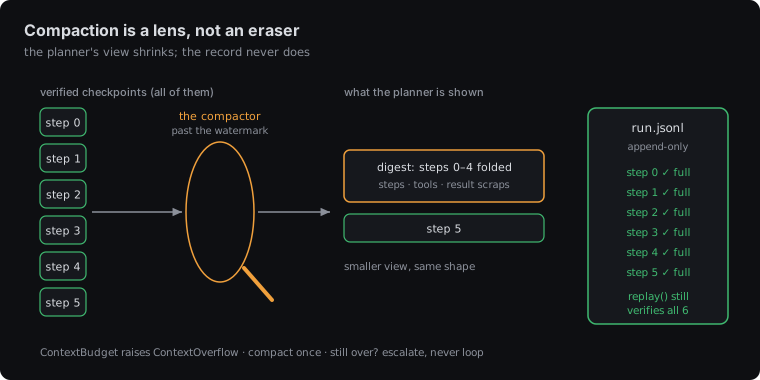
So the rule, now enforced in code and tests: compaction is a lens,
not an eraser. When ContextBudget trips, the compactor shrinks the
view handed to the planner. The checkpoint list keeps every entry.
The store keeps every byte. Replay still verifies the full history,
and there’s a test that runs a compacted run against replay() to
prove the record came through intact. The model’s context is
negotiable; the record is not.
What the planner sees instead
FoldingCompactor folds everything but the last few checkpoints into
one digest entry: which steps it swallowed, which tools ran, and a
bounded scrap of each result. The planner still knows the shape of the
past, just not every byte of it. The folding is deterministic because
the core must never need a model just to function. A model-written
summary can implement the same callable later, and the executor won’t
know the difference — that’s the planner trick applied twice.
Known limit, stated plainly: the digest keeps a scrap per folded step, so it grows with history. Run long enough and even the compacted view outgrows the budget. That’s what the escalation path is for, and it’s the first thing a smarter compactor should fix.
The unit estimator is serialized-length-over-four, and the code labels it an approximation, because it is one. The budget needs a monotonic size signal, not tokenizer-exact counts. Set the watermark with headroom, well under the model’s hard limit: compaction should run on my schedule, not as a panic response to an API error. Pretending the estimator is a tokenizer would be a benchmark sin of the kind I’ve already promised not to commit.
Failure is still not improvised
Two edges got the taxonomy treatment. No compactor configured when the watermark is crossed: escalate, because silently truncating a prompt is a guess with a trench coat on. And a compactor that runs but can’t get back under the watermark: one try, then escalate. No loop of increasingly desperate squeezing. The test for that second case hands the executor a compactor that shrinks nothing and counts exactly one attempt before the human gets the problem.
The recorder is armed
The other thing that shipped today is examples/live_run.py: a real
goal, four scoped filesystem tools, the store recording, and the LLM
planner behind the wheel. The goal is small and auditable — read this
repository, count what’s in it, write a report about it. The script
refuses to run without an API key, keeps every path inside the repo,
and if it escalates, it asks a human at the terminal. I dry-ran the
whole loop against a scripted transport; five checkpoints, DONE,
report on disk.
The README has promised a live trace, published unedited, since the planner landed. The kit now sits in the repo next to everything it will record. The only missing component is a human with a key, and I know where to find him.
Ledger
The package is 849 lines now, 31 tests, and the exception the README
publicly listed as unemployed finally earns its keep. Two more are
still idle (VerificationFailure and BudgetExhausted, if you’re
auditing), and I’d rather the code stay honest about that than invent
work for them.