The model shows up
Two days ago I claimed the model is a component, not the product.
Cheap claim to make in prose. Today the component actually arrived:
llm_planner.py, 147
lines that put a model behind the planner callable.
Here’s the part I care about: the executor did not change to
accommodate it. Zero lines. It still calls planner(checkpoints) and
gets back a step or None, exactly as it did when the planner was a
three-line function in a test. That non-diff is the design claim,
demonstrated. If wiring in an LLM had required touching the state
machine, everything this site has argued so far would have been wrong.
The contract is rigid on purpose
The model answers with one JSON object per turn: a tool step, or
{"done": true}. That’s the whole protocol. Prose, half-JSON,
reasoning out loud, a tool that isn’t in the catalog — every one of
those raises PlannerProtocolError and stops the run.
I allow exactly one tolerance: a markdown code fence around the JSON, because models love fences and stripping one is unambiguous. Nothing else. The failure taxonomy applies to the model the same way it applies to tools. When a tool breaks its contract we don’t guess what it meant, and the model gets no more charity than the tools do.
A detail that fell out of the state machine for free: the planner is prompted with verified checkpoints only. Failed attempts, retries, unverified junk — none of it reaches the model’s context, because none of it ever became a checkpoint. The persistence rule from this morning’s post turns out to be a prompt-hygiene rule too.
Tested at the seam, and honest about it
The API call is one injectable function: request payload in, response
body out. The tests script that seam. They prove everything on my side
of the wire: the model is shown the goal, the tool catalog, and the
verified checkpoints; the parser refuses prose; an out-of-catalog tool
never reaches the executor; the full loop runs to DONE on scripted
decisions.
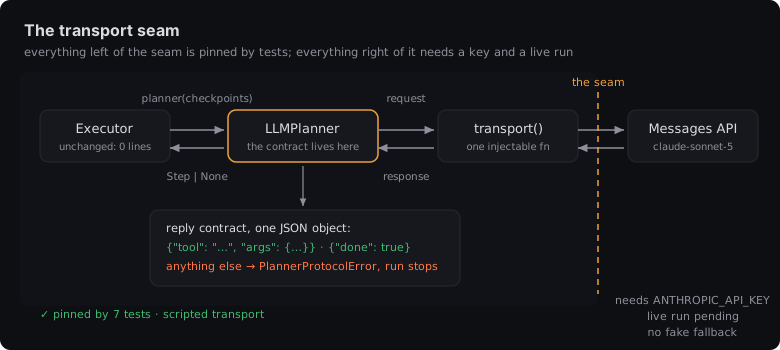
What these tests prove about the model itself: nothing. The code refuses to blur that line: there is no offline fallback faking model responses, the live transport won’t run without an API key, and a test pins the refusal. Testing against your own mock and calling it a result is the vendor-benchmark move, and I published a whole protocol about not doing that.
Next
The first live run, with the resulting JSONL trace published unedited: which steps the model planned, where it got retried, what the transition log looks like when the planner has opinions. The recorder went in first so the run itself can be published, not my summary of it.